Azure Cost Monitor: X-Mas Update

The time around christmas gave us the time to fix a couple of small issues which are annoying but not critical in the day by day business. With this article I would like to highlight the small but important changes in the Azure Cost Monitor:

HTTPs enforced
The Azure Cost Monitor is now available via https only. Every access to the http url will be redirected to the secure endpoint. This should prevent accidental unsafe usage of sensitive data via http.

No more hashbangs
In the past the Azure Cost Monitor used URLs with hashbangs in it,  which are unreadable and not easy to remember. As the hashbangs aren’t used in the urls anymore, please update your bookmarks.

Remove Contracts
Are you a customer with multiple EA contracts or a service provider who is working for several EA customers? If so, this feature is for you. Users with multiple contracts now can see a little trash icon in the contract dropdown, which allows to remove a non-active contract from the system. This should give everybody the option to stay clean with his data.

Daily Sync
The Azure Cost Monitor now syncs the data of the current month automatically every night. As soon as a new contract comes into the system, also the existing historic data will be synced. So the manually triggered action for data sync isn’t needed anymore and it will be removed in the next weeks.

Last Sync Time
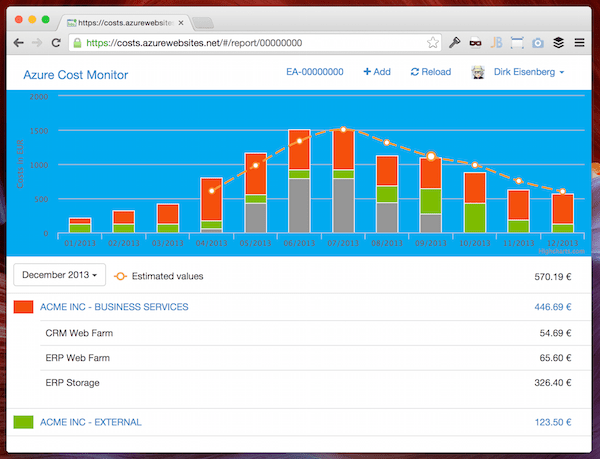
The last sync time for every month is now visible in the report sheet. This should give everybody more transparency and control about the automated processes in the backend. Whenever you recognize a last sync time higher than 24 hours, please open a ticket.

Screen Shot 2014-12-29 at 10.39.20

We hope these little improvements will help everybody to get a much better experience with the Azure Cost Monitor. If you have any other wishes, feel free to request them in our feedback portal.
Clear cost control based on service types

The Microsoft Azure Cloud offers many different resources, e.g. virtual machines, cloud services or websites. Some of these resources produce comprehensible costs e.g. virtual machines, but some resources produce costs that are indirect and hard to analyse, like costs for “Data Traffic”, “Visual Studio Online” or “Data Management”.

Screen Shot 2014-12-06 at 12.11.51

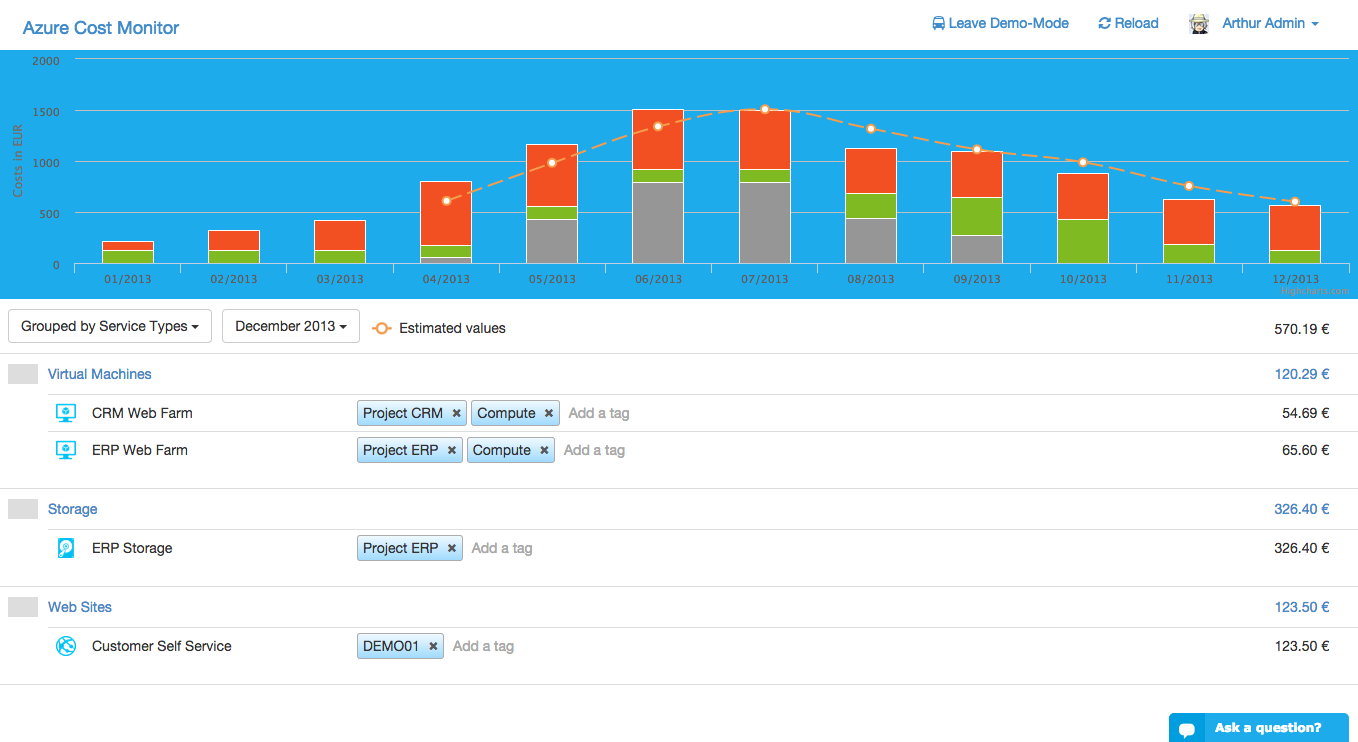
To solve this problem and facilitate the cost control, all service types are now visible in the Azure Cost Monitor. The new category for grouping this service types helps to identify the cost drivers in different subscriptions and projects.

Azure Cost management with resource tagging

Starting with Microsoft Azure teams or small departments often begin with one subscription. When time goes by the subscription contains more and more resources without a simple option to migrate them into new project specific subscriptions. Managing costs for this kind of subscription is not easy. Because of that the Azure Cost Monitor now offers a new feature which should really help to stay in control.

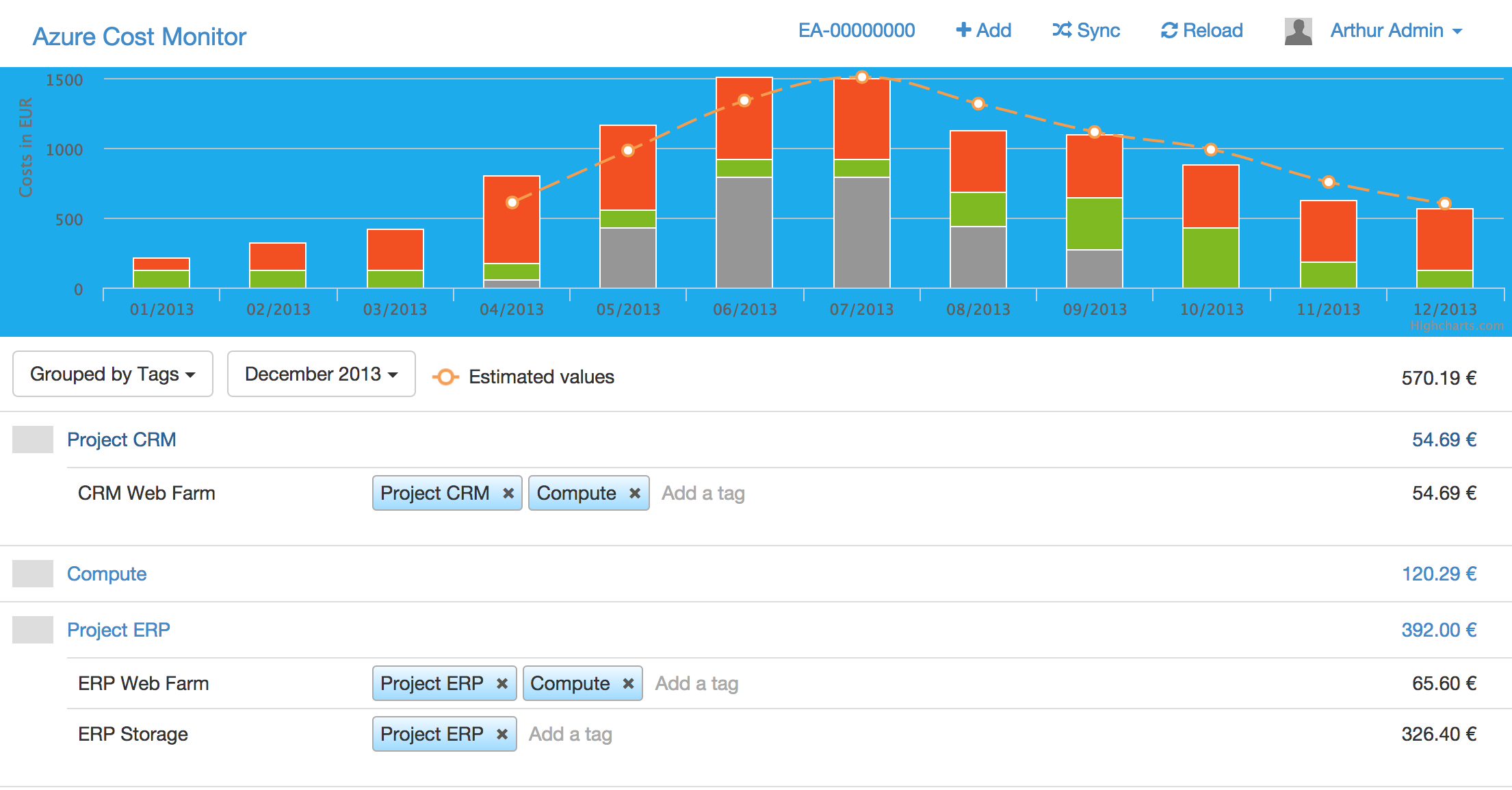
The new “Cost Tags” feature is an easy and comfortable way to categorize services. These tags can easily be used to visualize costs per responsible person, department, project or cost center. This allows cost management on a very granular level and aligned to the individual existing organisational structure.

The following screenshots show some best practices:

ScreenProjects
Categorize your services by project groups that are responsible for the costs

ScreenTypes
Categorize your services by resource type, e.g. storage or compute

This should really help to bring more control and transparancy into the Azure EA agreement. If you see any other requirements or needs feel free to drop the idea in our feedback portal.

BTW: As soon as Microsoft Azure delivers the new Azure resource tagging we will allow to mix up our custom tags and the Azure resource tags. There will be no need to do something manually from your side.

Azure Enterprise Agreement: Freedom & cost control

Microsoft offers a very lucrative deal for Azure customers: When your company is willing to do an upfront investment it’s possible to get an enterprise agreement. Besides dramatical price reduction this agreement gives your engineers the freedom to consume azure services as much as they need, the operations team is able to assign subscriptions for every team and your company gets an invoice that is compliant to local financial regulations.

But what about your financial controllers? How can they keep track of the costs to ensure that the the limits are not exceeded?

Here are some best practices that Microsoft offers to partly achieve this:

  1. Check your EA reports on a weekly basis
    Microsoft delivers weekly consumption report that need to be checked on a regular basis. A second important source is the monthly delivered summary e-mail about the monetary commitment balance.
  2. Assign your teams, business units or projects to different subscriptions
    Microsoft allows to create as many subscriptions as needed, this means it’s possible to give every team or project a separate subscription payed from the enterprise agreement. By that access rights and roles can be modelled.

After working with these two options I recognised that not all of my requirements to manage our costs efficiently were totally fulfilled:

  1. Multiple usage of the same service should be cumulated in one report entry.
  2. Analysing costs on subscription level without using a complex pivot table.
  3. Tagging different resources helps to manage multiple projects in a subscription.
  4. Cost-Prediction based on the data of the past months.
  5. Cost-Alerts when specific limits are exceed for enabled EA customers.

So I decided to build a little service based on the Azure platform, called Azure Cost Monitor:

The service is able to process the CSV files from the EA portal and gives a graphical overview including subscription drill down. It is based on modern cloud technologies exclusively e.g. Azure Table Store, Azure WebSites and Azure WebJobs. That’s why the Azure Cost Monitor scales as good as Azure scales and I would like to invite all of you to join this service (https://costs.azurewebsites.net).

login

Login with your existing Azure Account or LiveId. After that enter your EA number to start analysing your data. An useful report about the cost consumption of your subscriptions will be shown. If you don’t want to enter your personal data right now, feel free to check the demo mode by adding the demo EA number:

Screen Shot 2014-10-18 at 21.44.52

I would like to extend this service aligned to the requirements you bring from the field, so please visit the feedback portal of the Azure Cost Monitor and enter your ideas or vote and comment for existing ones.