Build your own Twitter – Part 3 – Azure Timeline Service for Node.js

The last part of this article series described the principles of Twitter-like services based on Azure Storage Tables. This part now describes the structure of a new node module which acts as a timeline service. This service can be used very easily in existing node projects.

To integrate this node module just install the azure-timeline-service via node package manager. This integrates everything that is required automatically:

npm install azure-timeline –save

The module allows to post events to a specific user timeline and the timeline of all followers. The following snip-let illustrates it:

var user = azureTimelineService.createSubject(“<>”, “<>”);

user.postEvent(‘login’, { timestamp: new Date() }).then(function() {
console.log(“DONE”);
});

Every method works asynchronous based on promises. Following another user is as simple as posting an event to a timeline

user.follow(user01).then(function() {
console.log(“DONE”);
})

Following a user means all events this user posts to a timeline will be posted to the followers timeline as well. Last but not least loading a timeline is important. The system returns currently all events from a timeline which is a point of change in the future:

user.loadTimeline().then(function(events) {
console.log(events);
})

All samples are implemented in the sample file of the Azure Timeline project here. Any questions? Feel free to open an issue at GitHub or just stay in touch via this block.
Azure Cost Monitor for Service Providers & Resellers

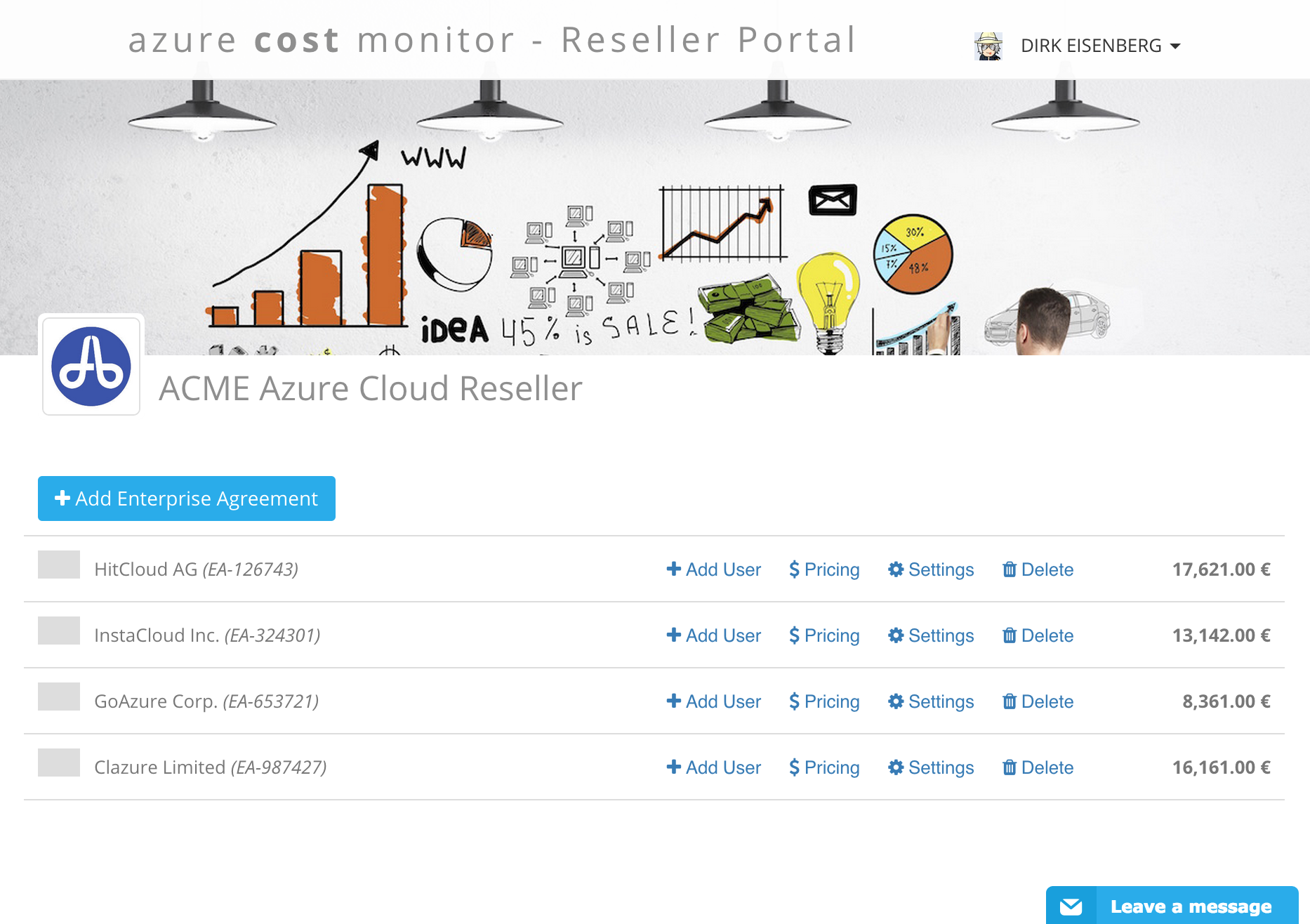
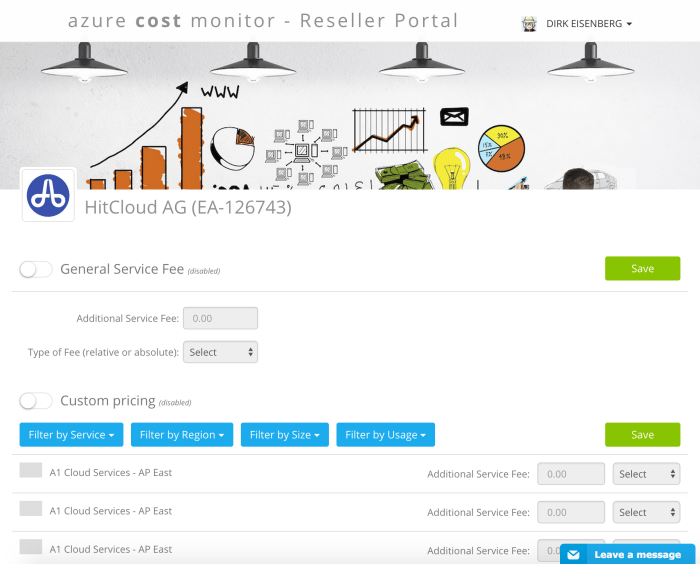
Are you an Azure reseller or a cloud service provider offering Microsoft Azure services? If so, we start offering you a smarter way to have control about the cloud spendings of your customers or to give your customers a great monitoring tool, seamlessly integrated in your service architecture. The Azure Cost Monitor Reseller Portal is a new way for service providers and resellers to monitor, manage & measure costs in the Microsoft Azure cloud:

csp01

Besides the Enterprise Edition features, the portal will come with these additional features:

  • Customer Management Dashboard
    Manage access to the Azure account or a specific subscription for your customers. Invite new users or assign an existing Azure Active Directory group to provide access rights.
  • Custom SSL & Domain support
    Integrate the service seamlessly in your or the customers service architecture, with a service provider or customer specific domain incl. SSL certificates.
  • Custom pricing & currency support
    Especially when you resell just a simple subscription or if you add some reseller service charges to the pricing, a custom pricing table helps you to manage this complexity.
  • Data access via RESTful API
    A strong integration, e.g. into an existing data warehouse or CRM application is easy and simple with the existing RESTful API.
  • Allows to resell enterprise editions
    Having a reseller edition allows every reseller and cloud service provider to resell Azure Cost Monitor enterprise editions with an individual margin.

Interested? Signup for the early adaptor program and get direct access to the current system.

csp02

We hope this feature makes it simple to maintain your customers with the Azure Cost Monitor and makes it much easier for you to manage and control all costs. Any questions, wishes or ideas? Try our feedback portal or drop a mail to help@azure-costs.com.

Build your own Twitter – Part 2 – Azure Table Structures

Azure Table Store offers a very important scalability feature which should be used when working with timelines. The partitionkey in every table allows Microsoft to put entities on different servers. Let’s recheck the limits of Azure Table Store to make a right decision (http://azure.microsoft.com/en-us/documentation/articles/azure-subscription-service-limits):

  1. Azure Table Store returns 1000 entities per page. If the result contains more entities the client needs to query several times -> A timeline service should never page to render the first timeline
  2. Azure Table Store returns 2000 entities with 1KB of size per second as a guaranteed SLA –> A timeline service should never request more data per page to stay performant
  3. Azure Table Store allows to store up to 500TB per storage account, it could be stored in one table or different –> A timeline service should be able to handle several storage accounts, at least theoretically.

With all this limitations in mind it’s possible to build a table structure for the timeline service as follows:

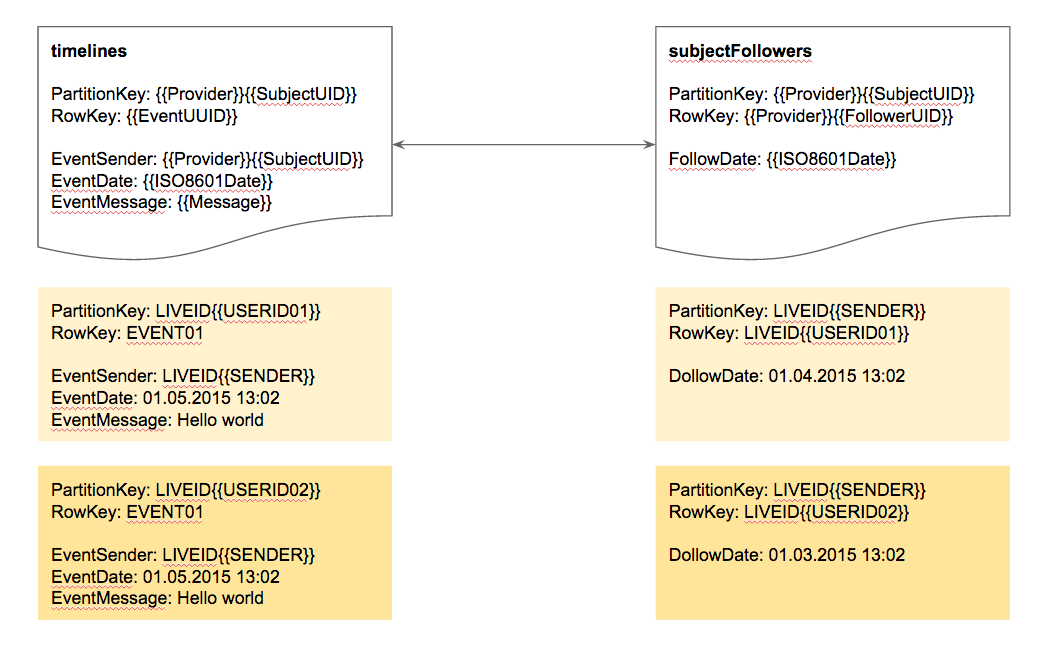
  1. timelines
    The timlines table contains all timelines the system has registered. The partitionkey of this table is timeline identifier so every subjects timeline can be stored on different nodes. The partitionkey should be a key generated from the subjects  identification, e.g. liveid{{UID of LiveId-Token}}. This prevents the system to lookup an other table to get the timeline identifier when the subject tries to render them.In addition the event which should be stored on several timelines can be identified by his event identifier as the row key. This allows the system to also implement removal jobs because a multiple stored event can be identified as the single one.
  2. subjectFollowers
    the subjectFollowers are a list of subjects following a specific subject. The partitionkey of this table is also the subject identifier so it’s easy to get all followers of a subject. In addition the row key becomes important because it identifies the subject who is following someone else. This gives a system the option to find all followers of a specific subject and all subjects a specific subject is following very fast. Works well in both directions.

This simple data structure allows the service to handle hundreds of different timelines and relations. Especially the background worker can now identify on which timeline the event needs to be stored.

followers

Last but not least, when it comes to requesting the timeline content it will only be returned in pages of 250 elements to stay healthy with the performance. An other page can be requested at any time when the user starts paging.

Azure Cost Monitor sends notifications when Azure EA token has expired

Microsoft offers all EA customers the Azure EA portal to manage different accounts and subscriptions. In addition to this portal, every customer can issue up to two security tokens to 3rd party applications. This allows the applications to interact and work with the customers EA data like the Azure Cost Monitor is doing.

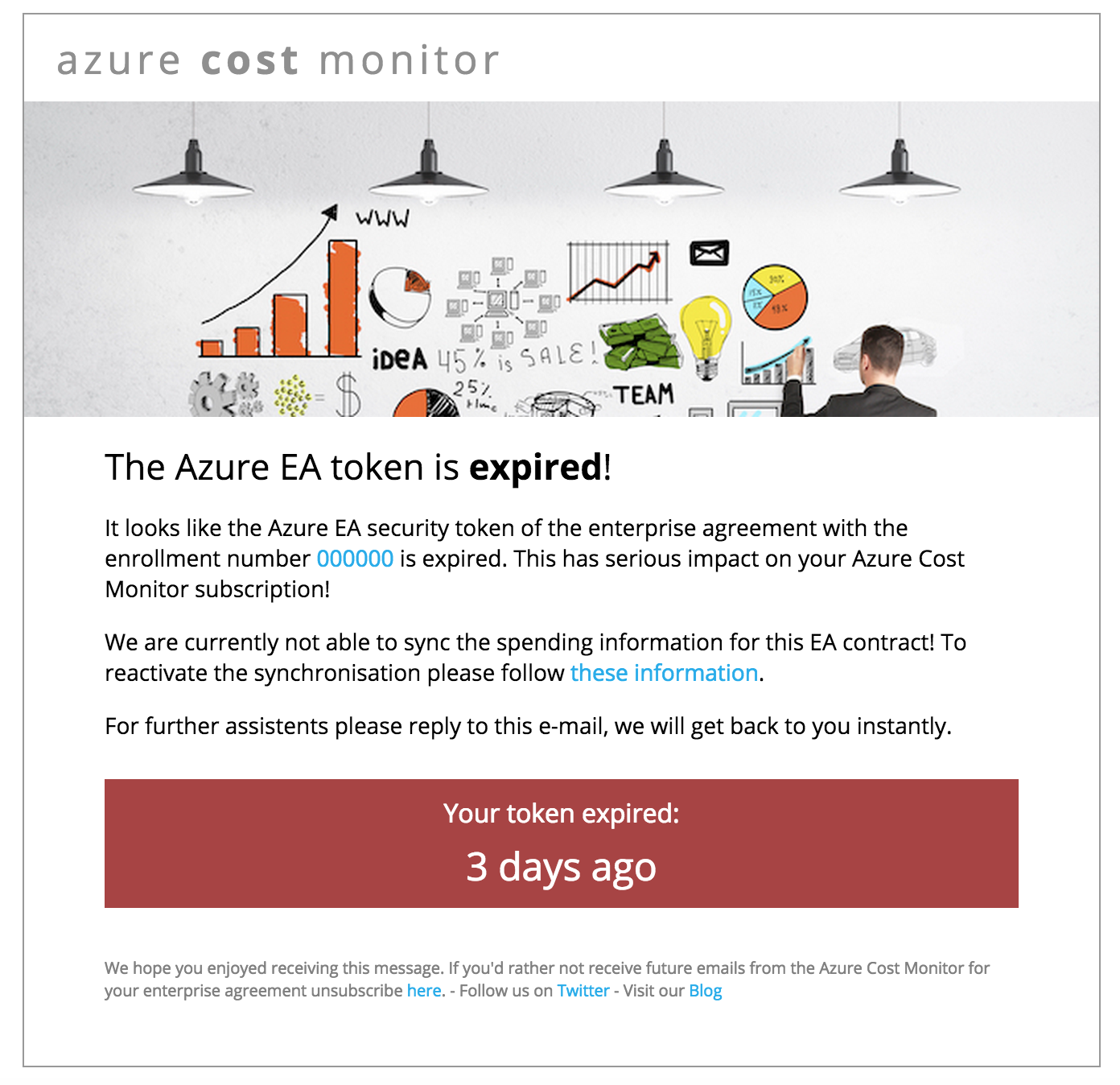
Starting this week the Azure Cost Monitor analyses the existing Azure EA security tokens and is able to detect when a token has expired. As soon an expired token is detected the owner of the contract will get an information via mail:

blog-azure-cost-ea-token-expired

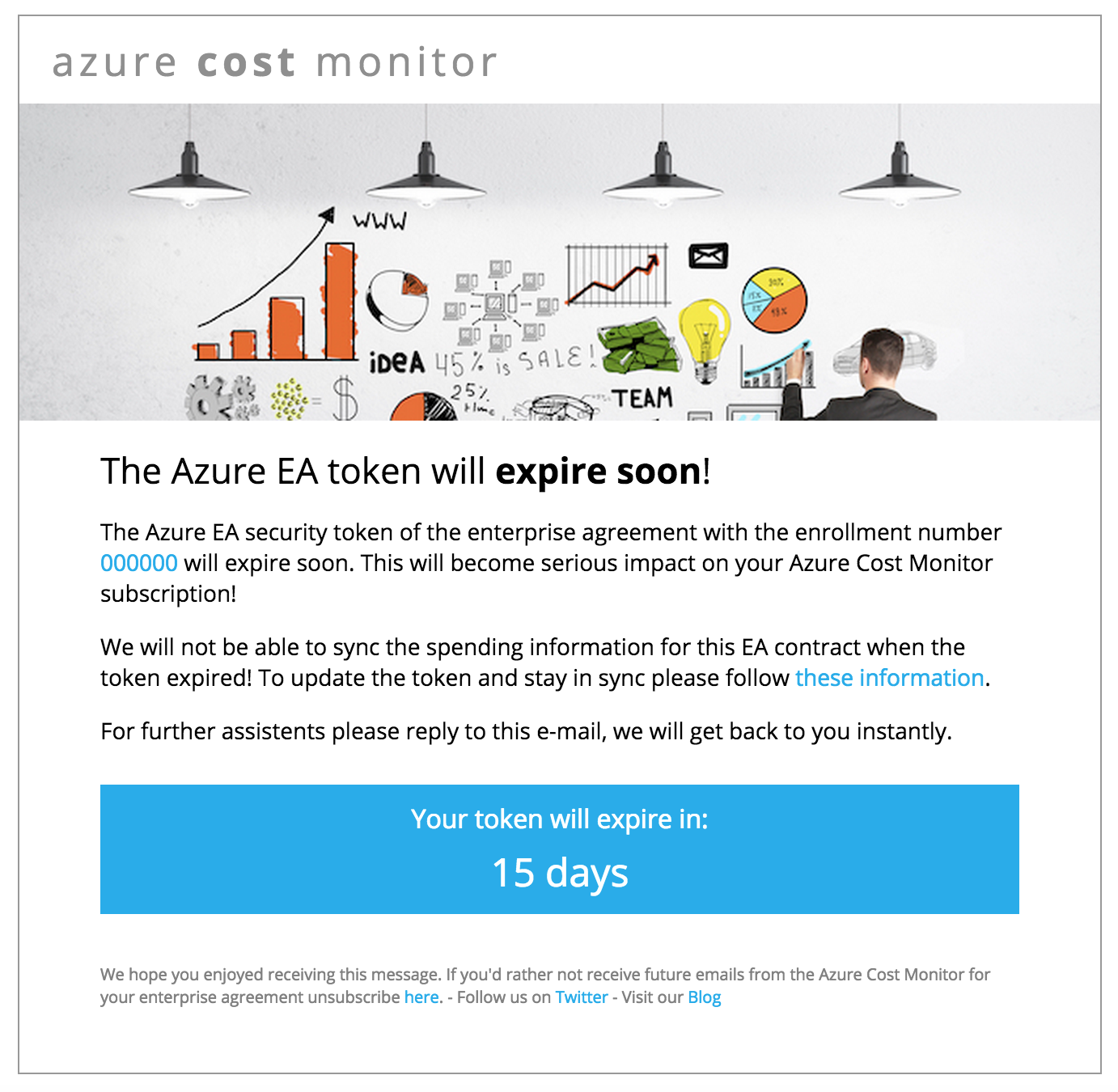
In addition, the Azure Cost Monitor is now able to warn about tokens that will expire very soon. The owner of the affected contract will get an information via mail as well:

blog-azure-cost-ea-token-will-expire

This new feature should help you as a contract owner to stay in sync every day. It also helps us to have our system stay healthy and performant every day. Please update the tokens directly when you get this kind of notifications. Additional information on how to renew a token can be found in our knowledge base here.

We hope this feature makes it simple to maintain your Azure Cost Monitor account and makes it much easier for you to manage and control all costs. Any questions, wishes or ideas? Try our feedback portal or drop a mail to tickets@azurecostmonitor.uservoice.com.

Pit-Falls when you integrate Twitter, Facebook or other social networks

Today I received a request from a platform to vote for a specific product. I was willing todo this, because I’m using it every day and I’m really happy with that.

With this kind of sentences discussions about failed social media integration start. In a world where many people are very concerned about their own data privacy a “but” follows very fast:

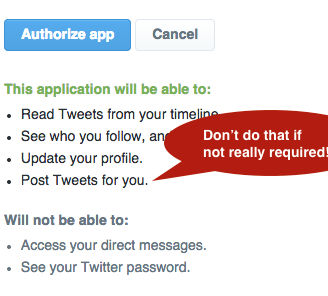
Currently I can’t do that because the website enforces me to authorise via Twitter or Facebook. This would be doable if they only request the rights they really need. I will not allow every system to post in my name because that’s very personal.

At the end of the story you as a service provider loose a customer on the click path for only one reason: You tried to get more rights as you typically need to operate your application. And from my own experience the right to post in the name of someone requires a strong trustworthy relationship.

Screen Shot 2015-03-06 at 07.32.16

Neither Twitter nor Facebook enforces any developer to request more rights than they really need. I did a lot of Twitter integrations and whenever you are doing this please check the FAQ of the identity provider of your choice clearly and follow the principal of minimal privileges.

Following this ideas you will loose less people on click path to your voting system!

Update expired Azure EA tokens easily

The Microsoft Azure EA portal issues an Azure EA security token for API access to the cost & usage data. This token expires every 6 month and because of that needs to be renewed in the Azure Cost Monitor on a regular basis. The Azure Cost Monitor team started the project about 5 months ago what means that the first Azure EA security tokens will expire soon. Because of that, we are pleased to announce the launch of the token update wizard which makes it as easy as possible to renew expired Azure EA tokens:

azure-ea-token-settings

From today, the dashboard of the Azure Cost Monitor warns every user when the token is expired to ensure that every administrator always stays informed:

azure-ea-token-warning

If you don’t update an expired token, the system stops syncing data from the Azure EA portal. As soon as the token is valid again the system is able to sync data from the Azure EA portal and is doing that automatically within the next sync cycle over night. We will also get the missed data from the days the token was expired. So no worries when you were in vacation or absent for a couple days.

We hope this feature makes it simple to maintain your Azure Cost Monitor account and makes it much easier for you to manage and control all costs. Any questions, wishes or ideas? Try our feedback portal or drop a mail to tickets@azurecostmonitor.uservoice.com.

Azure: Do never use EF automigrations when working in teams

Todays number one approach in building database access libraries on ASP.NET based applications is the Entity Framework. Since Microsoft supports migration based database updates, which mostly look like copied from the approach Ruby on Rails offers since ages, it’s possible to use them in scenarios where continuous deployment is key.

The core model which fits perfectly into a development process around continuous delivery & deployment is a code-first approach. This means that the developer creates so called POCOs (Plain Old C# Object) and the system is able to generate the needed SQL changes, based on the current state of the database.

The Entity Framework has two options to generate the migration:

  1. Auto Migrations
    The Entity Framework tries to generate the database changes on runtime without any specific migrations implemented as code. Everything happens magically 😦
  2. Explicit Migrations
    The Entity Framework just runs the migration scripts written in a .NET based special DSL for database operations. Nothing happens magically 🙂 This needs the developers brain but is controllable even in large teams.

When you work in a team Auto Migrations are really a bad idea and should be disabled from the beginning. Assume developers do changes manually in the database which means the magic around AutoMigrations will generate a different set on instructions against this database as the next developer will get. The results of auto migrations in team environments are not reliable and repeatable.

So it’s a really good idea to disable automatic migrations from the start:

public Configuration()  {
AutomaticMigrationsEnabled = false;
}

Auto Migrations do not have a win at all when it comes to projects with more than one developer or projects which are deployed automatically. Continuous deployment relies on a strict unit of work and as less magic as possible. This will also help to troubleshoot when the continuous deployment breaks the production and a rollback is required.

Microsoft also published a nice article with more information at the MSDN: http://msdn.microsoft.com/en-US/data/jj554735.aspx

Manage costs in your local currency – Azure Cost Monitor supports multiple currencies

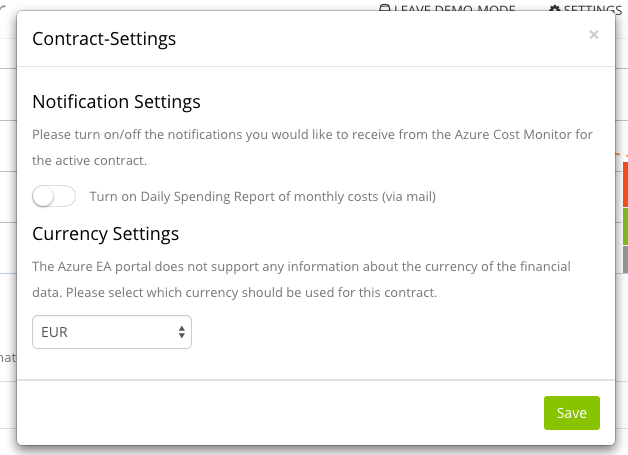
The azure cost monitor team is pleased to announce the launch of the multi currency support. This  feature has been built to reflect what our users told us they need:

acm_currency

Currently the Microsoft Azure EA portal does not give any information about the currency of the financial data. Because of that the azure cost monitor displayed all costs in EUR in the past. Now the new multi currency support allows to switch between different currencies.

We hope this feature brings more transparency in your Azure Cloud Spendings and makes it much easier for you to manage and control all costs. Any questions, wishes or ideas? Try our feedback portal or drop a mail to tickets@azurecostmonitor.uservoice.com.

Azure Storage: Is the Geo Redundant Mode really required?

Microsoft Azure offers different replication modes for Azure Storage. Every mode approximately doubles the costs for a TB of data. During a great workshop with Patrick Heyde we talked about stamp copies and I asked myself which mode I really needed.

First I took one step back, to identify all requirements I typically have in my projects for a highly scalable, fault safe, redundant storage :

  • When a hard-drive in a storage server brakes, my data still needs to be usable.
  • When Microsoft has huge power outage on a whole datacenter, I want to bring my app up and running again in another datacenter.
  • When I (or my customers) are removing data by accident, there needs to be an option to revert to a former snapshot.

So a review of the different replication modes compared to these requirements leads me to the following results:

When a hard-drive in a storage server brakes, my data still needs to be usable:
The Local Redundant Storage fulfils this requirement perfectly. Microsoft writes 3 different copies of every bit within one single data center. When a hard drive on a stamp or the whole stamp goes down, another one can take over and all data is available without any interruption.

When Microsoft has huge power outage on a whole datacenter, I want to bring my app up and running again in another datacenter:
Microsoft offers a geographical redundant storage mode that stores another 3 copies in another datacenter a hundred miles away. This helps a lot, because every application can use the secondary location to access to the data – but is it worth the price? The price for GRS is three times higher then for LRS.
An automated replication between two different LRS storages, hosted in a Azure WebJob might be a good solution the fulfill the requirement as well.

When I (or my customers) are removing data by accident, there needs to be an option to revert to a former snapshot:
Globally Redundant Storage is not helpful when it comes to removing data by accident. As soon as the data is removed from the primary storage, the system removes the data in the backup location as well, often within seconds.
But this requirement can also be fulfilled with a replication between two different LRS storages, as already described above. The whole application needs to be designed for this use cases.

So this review brings me to the conclusion that in my personal opinion GRS storage is not needed in most of the use cases. Normally several LRS storages and an application logic optimised on the specific data security requirements works well and preserves the budget.

What’s your opinion? Do you have use cases where GRS and Read-GRS are hard requirements? If you like, leave a short comment …

Stay up to date – Azure Cost Monitor starts sending daily spending reports via mail

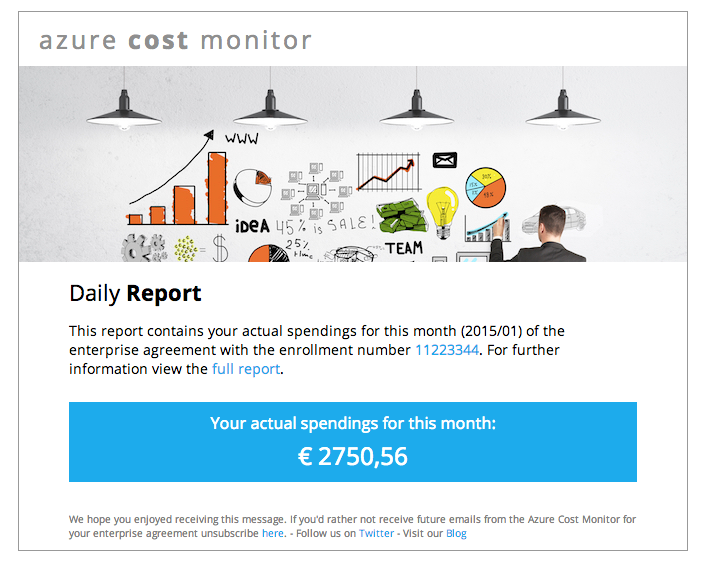
The azure cost monitor team is pleased to announce the launch of the daily spending mail reports starting January 17th. This great feature has been crafted to reflect what our users told us they need and it also builds upon new technology capable of addressing future needs:

spending-report-demo

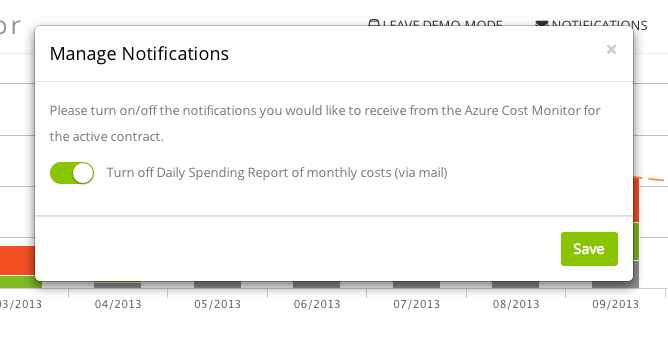
The report will be send once a day, at about 03:00 AM CET. If – for any reason – you do not wish to get the daily reports, it’s of course possible to disable the reports in the new notifications section of the Azure Cost Monitor portal:

notifications

We hope this feature brings more transparency in your Azure Cloud Spendings and makes it much easier for you to manage and control all costs.
Any questions, wishes or ideas? Try our feedback portal or drop a mail to tickets@azurecostmonitor.uservoice.com.